Translate
Thursday, 28 September 2017
The Linguistic Philosophy of Tolkaapiyar - Part 4
The Syntax and Semantics of Tolkaappiyam
Let us keep in mind that for Tol the MEANINGS constitute the basis for linguistic studies and hence the various kinds of COMMUNICATIVE acts - verbal and nonverbal - are the events that are studied.
Such studies are complied as PoruLatikaaram where PoruL here means the MEANINGS people live with and hence a kind of existential analytics. Now the Second Book Collatikaaram (Col) deals very specifically with the Coherence of Discourse and the syntactic and semantic issues related to that. The kiLavi, the meaningful utterance becomes the unit that is analyzed and where COHERENCE of sentence structure is dealt with. It is here GRAMMAR in the strict sense of the word, evolves with delineation of the RULES implicit in the structure of sentences coherent both syntactically and semantically.
The Eccaviyal, the final chapter is of peculiar importance for here we have not only a discussion of the agglutination of Noun Phrases but also a kind of Linguistic Survey of ancient India where almost all Indian languages are classified into Centamil and Koduntamil with Sanskrit separated out as Vadamozi i.e. the Northern Language, or Dead Language (pada> vada: to be dead)
The Book begins, interestingly enough with a chapter on KiLaviyaakkam, the formative processes of speech and which turns out to be actually a Discourse Analysis where the units of discourse, the KiLavi are various kinds of Speech Acts like questioning, replying, requesting, commanding and so forth. After that it begins an analysis of the constituents of such linguistic units and for which purposes the Case Markers are studied followed with an analysis of ViLi Marabu or the Vocative that is quite intimately related to the cases. Then we have an extensive analysis of the Noun Phrases (NP) followed with an equally extensive analysis of Verb Phrases (VP). Then we have a study of what are called Idaiccol- the particles, enclitics and so forth followed with Uriyiyal that gave rise to the tradition of dictionaries - the explication of the meaning of rare words with commonly occurring words. One could say that this chapter of Uriyiyal is the first DICTIONARY or NikaNdu in Tamil, that set the model for some ancient NikaNdus like Tivaakaram and so forth, which finally led to a proper dictionary, the Caturakaraty of Rev Beschi or Viramamunivar (c. 17th cent)
The final chapter is Eccaviyal and which literally means the Chapter on matters that were left out in the earlier chapters. In seeking out what kind of words can legitimately be used in literary compositions, Tol ranges very wide into all the languages of India and classifies them variously. It is here that we find an explicit mention of Sanskrit and the rules that must be applied to words that have phonemes peculiar to that language before being accepted into Tamil.
KiLaviyaakkam: Discourse Analysis
This is the chapter which not only that sets the framework for the various rules of grammar that are noted later but also that which links up with PoruLatikaaram, the third book.
The Discourse is an organized dialogue with questions and replies alternating but with a COHERENCE of their own and which is RULE BOUND. Now here the notion of coherence is tackled at several levels- the discourse level, the sentential level and morphological levels. For example for a discourse to be coherent it is noted that a reply to a question must be relevant to the issue raised by the question and that sometimes a counter question itself can serve as an implicit reply. Quite interesting in this matter is the observation that when questions are raised about nonexistent objects like Flower in the Sky and so forth, it is WRONG to reply positively or negatively, as that would implicate that one accepts the existence of the object. The best thing to do under such circumstances is to refuse a reply and remain SILENT. Questions about nonexistent objects terminate the dynamic flow of the discourse itself and hence nonproductive.
Now grammatical considerations proper begins only at the level of coherences at the sentential level and it is here that the basic categories like TiNai (person non-person gender distinctions) the number (one and many), the pronominal considerations ( the firrd person, second person etc), tenses and aspects and so forth are considered along with the distinction between NP and VP, the basic constituents of all sentences that have a coherent meaning. There are morphological elements like number indicating infixes both in the NP and VP and there must be AGREEMENT between the NP and VP of a single sentence for it to be grammatically acceptable. So is the case with other categories like gender tense pronominal structures and so forth.
ULLAGANAR
( editing and re-paragraphing by his student )
Sunday, 24 September 2017
The works of Professor Sathasivam linking Tamil with Sumerian.
Taken from https://www.tamilnet.com/art.html?catid=79&artid=38813 with thanks.
Four pioneering research papers on the Dravidian connections between ancient Sumerian and Tamil, written between 1964 and 1987 by Eezham Tamil scholar, the late Prof A Sathasivam, are now available as a book. Writing a note to one of those papers in 1965, renowned linguist Prof T. Burrow said that Sathasivam breaks new ground in seeking to relate Dravidian with Sumerian, and added that if it were to be accepted the theory would be of considerable importance for the prehistory of both Dravidian and Sumerian. Brought out by the efforts of Mrs T Sathasivam and edited by Dr. Siva Thiagarajah, the book titled “Proto Sumero Dravidian: The Common Origin of Sumerian and Dravidian Languages,” has been published this year by the History and Heritage Unit of the Tamil Information Centre in the UK.
The papers are only a small but valuable fraction of the quarter a century research undertaken by Prof Sathasivam. He was working on a magnum opus, an etymological dictionary of Sumero Dravidian.
Commenting on his research, another renowned linguist Prof M. B. Emeneau wrote in 1965 that the analysis he had begun would be waited for with great interest, because of the most interesting historical and prehistorical implications of this hypothesis.
Sathasivam’s research gains new significance today because of the current advancements in coupling linguistics with DNA studies.
Unfortunately, his untimely demise in 1988 halted the completion of the work, but he has left behind volumes of manuscripts. Mrs Sathasivam should be given moral support and encouragement to bring them out in print for the great benefit of world scholarship.
The book that has been published now includes a monograph he prepared at the universities of Pennsylvania and California in 1964-1965, two papers he later read at the International Conference Seminar of Tamil Studies in 1966 and 1987, and another paper he read at the Seminar on Dravidian Linguistics, Annamalainagar in 1969.
* * *
Sumerian civilization was one of the earliest of world humanity. 6000 years ago, it was flourishing in the cities, Ur, Uruk, Eridu, Larsa, Lagesh, Nippur etc., in lower Mesopotamia, which is roughly modern Iraq.
The authors of the Sumerian civilization were different from the later Babylonians and the present day Semitic populations. The Sumerians themselves were immigrants to Sumeria.
Unlike the Indus writing, the Cuneiform writings of the Sumerians became possible for decipherment with phonetic and semantic values, because of the availability of Semitic Akkadian inscriptions of later times using the same script and trilingual inscriptions in Akkadian, Elamite and old Persian.
Ever since the decipherment of Sumerian, seeing it different from Aryan or Semitic, theories were postulated as early as in 1912, linking Sumerian with Dravidian and Indus Valley.
Sathasivam found the Sumerian language as described in Sumerian grammars possessing almost identical characteristics with those of his reconstruction of prehistoric Tamil.
In his monograph he has brought in 501 cognate sets to compare Sumerian with various Dravidian languages.
Noting Sumerian and Dravidian as agglutinative languages, Sathasivam says that both have genetic relationship.
“The Sumerian language of the Archaic (3500-3000 BC) and Ur dynastic (3000-2400 BC) periods had preserved well its Proto-Dravidian elements,” Sathasivam observes.
“Both Sumerians and Dravidians spoke the same language and probably lived in some mountainous region for a long time before they separated from each other,” he further observes.
He concludes that Sumerian language fits in neatly as a member of the Dravidian family.
Pointing out Sumer meaning cultivated land, and citing the S/ K interchange, Sathasivam compares it with Kumari meaning cultivation in hills in Tamil, a piece of ground in a jungle in Kannada and Kumeru meaning a waste land cleared for cultivation in Tulu. It is interesting to note that the Dravidian strain is preserved in Sinhala too, in which Kumburu means paddy field.
* * *
Born in 1926 in Vaddukkoaddai, Jaffna, Sathasivam had a brilliant and interesting academic career.
He became a traditional Tamil Pandit first, before going from Jaffna College to the then University of Ceylon in Colombo to do Tamil honours and Master’s degrees, and then to proceed to Oxford to do doctoral research under Prof Burrow. His research on Tamil verbs was a source used in the Dravidian Etymological Dictionary.
At the University of Ceylon in the early 1950s he was a student of Prof K. Kanapathippillai, who is even today highly admired for his farsightedness in training and preparing his students in various branches of Tamil studies. Sathasivam was chosen for linguistics.
Sathasivam served as Professor in the University of Ceylon and in the University of California. Apart from his scholarship in linguistics, he is also remembered for the anthology of Eezham Tamil poetry he compiled, covering a period of nearly 2000 years.
Dr. Siva Thiagarajah, the editor of Sathasivam’s papers, is a multi-disciplinary academic. He is a medical doctor-turned Ph.D. holder in Medical Genetics, specialized in prehistoric DNA studies. He has authored two voluminous books on peoples and cultures of early Ilangkai and on the Kantharodai civilization of Jaffna. He has a special taking on Sumeria. One of his early publications was the Tamil translation of the Epic of Gilkamesh, a Sumerian epic, said to be the earliest of that genre of literature.
The 1964 - monograph of Prof Sathasivam was spotted by social anthropologist Mr. S. Visahan, while he was working at the British Library and an interest generated in the UK to bring it out in print. Mrs. Sathasivam who did the original typing of the manuscript 53 years ago, came forward to resurrect the research into a publication.
The book deserves attention of all in the field of world linguistics, Sumerian studies and Dravidian studies.
Sathasivam papers on Sumerian-Tamil connections see the light of day
[TamilNet, Wednesday, 20 September 2017, 23:37 GMT]Four pioneering research papers on the Dravidian connections between ancient Sumerian and Tamil, written between 1964 and 1987 by Eezham Tamil scholar, the late Prof A Sathasivam, are now available as a book. Writing a note to one of those papers in 1965, renowned linguist Prof T. Burrow said that Sathasivam breaks new ground in seeking to relate Dravidian with Sumerian, and added that if it were to be accepted the theory would be of considerable importance for the prehistory of both Dravidian and Sumerian. Brought out by the efforts of Mrs T Sathasivam and edited by Dr. Siva Thiagarajah, the book titled “Proto Sumero Dravidian: The Common Origin of Sumerian and Dravidian Languages,” has been published this year by the History and Heritage Unit of the Tamil Information Centre in the UK.
The papers are only a small but valuable fraction of the quarter a century research undertaken by Prof Sathasivam. He was working on a magnum opus, an etymological dictionary of Sumero Dravidian.
Commenting on his research, another renowned linguist Prof M. B. Emeneau wrote in 1965 that the analysis he had begun would be waited for with great interest, because of the most interesting historical and prehistorical implications of this hypothesis.
Sathasivam’s research gains new significance today because of the current advancements in coupling linguistics with DNA studies.
Unfortunately, his untimely demise in 1988 halted the completion of the work, but he has left behind volumes of manuscripts. Mrs Sathasivam should be given moral support and encouragement to bring them out in print for the great benefit of world scholarship.
The book that has been published now includes a monograph he prepared at the universities of Pennsylvania and California in 1964-1965, two papers he later read at the International Conference Seminar of Tamil Studies in 1966 and 1987, and another paper he read at the Seminar on Dravidian Linguistics, Annamalainagar in 1969.
Sumerian civilization was one of the earliest of world humanity. 6000 years ago, it was flourishing in the cities, Ur, Uruk, Eridu, Larsa, Lagesh, Nippur etc., in lower Mesopotamia, which is roughly modern Iraq.
The authors of the Sumerian civilization were different from the later Babylonians and the present day Semitic populations. The Sumerians themselves were immigrants to Sumeria.
Unlike the Indus writing, the Cuneiform writings of the Sumerians became possible for decipherment with phonetic and semantic values, because of the availability of Semitic Akkadian inscriptions of later times using the same script and trilingual inscriptions in Akkadian, Elamite and old Persian.
Ever since the decipherment of Sumerian, seeing it different from Aryan or Semitic, theories were postulated as early as in 1912, linking Sumerian with Dravidian and Indus Valley.
Sathasivam found the Sumerian language as described in Sumerian grammars possessing almost identical characteristics with those of his reconstruction of prehistoric Tamil.
In his monograph he has brought in 501 cognate sets to compare Sumerian with various Dravidian languages.
Noting Sumerian and Dravidian as agglutinative languages, Sathasivam says that both have genetic relationship.
“The Sumerian language of the Archaic (3500-3000 BC) and Ur dynastic (3000-2400 BC) periods had preserved well its Proto-Dravidian elements,” Sathasivam observes.
“Both Sumerians and Dravidians spoke the same language and probably lived in some mountainous region for a long time before they separated from each other,” he further observes.
He concludes that Sumerian language fits in neatly as a member of the Dravidian family.
Pointing out Sumer meaning cultivated land, and citing the S/ K interchange, Sathasivam compares it with Kumari meaning cultivation in hills in Tamil, a piece of ground in a jungle in Kannada and Kumeru meaning a waste land cleared for cultivation in Tulu. It is interesting to note that the Dravidian strain is preserved in Sinhala too, in which Kumburu means paddy field.

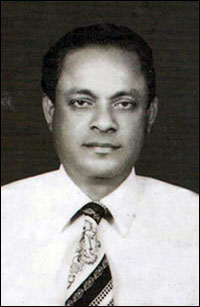
Professor A Sathasivam (1926 - 1988 )
He became a traditional Tamil Pandit first, before going from Jaffna College to the then University of Ceylon in Colombo to do Tamil honours and Master’s degrees, and then to proceed to Oxford to do doctoral research under Prof Burrow. His research on Tamil verbs was a source used in the Dravidian Etymological Dictionary.
At the University of Ceylon in the early 1950s he was a student of Prof K. Kanapathippillai, who is even today highly admired for his farsightedness in training and preparing his students in various branches of Tamil studies. Sathasivam was chosen for linguistics.
Sathasivam served as Professor in the University of Ceylon and in the University of California. Apart from his scholarship in linguistics, he is also remembered for the anthology of Eezham Tamil poetry he compiled, covering a period of nearly 2000 years.
Dr. Siva Thiagarajah, the editor of Sathasivam’s papers, is a multi-disciplinary academic. He is a medical doctor-turned Ph.D. holder in Medical Genetics, specialized in prehistoric DNA studies. He has authored two voluminous books on peoples and cultures of early Ilangkai and on the Kantharodai civilization of Jaffna. He has a special taking on Sumeria. One of his early publications was the Tamil translation of the Epic of Gilkamesh, a Sumerian epic, said to be the earliest of that genre of literature.
The 1964 - monograph of Prof Sathasivam was spotted by social anthropologist Mr. S. Visahan, while he was working at the British Library and an interest generated in the UK to bring it out in print. Mrs. Sathasivam who did the original typing of the manuscript 53 years ago, came forward to resurrect the research into a publication.
The book deserves attention of all in the field of world linguistics, Sumerian studies and Dravidian studies.
Friday, 22 September 2017
Random Thoughts Part 3 - Geneology and Teleology
Geneology and Teleology
The genelogical, how ideas originate and develop, in the Nietschean sense of the "Geneology of Morals" is simultaneously TELEOLOGICAL, a notion that distinguishes the Greek West from the Tamil East and perhaps along with it the whole of the East.
But this, it must be stated immediately, is NOT for the world, for World History but for the episodizing subject. There is NO END as such for the World and towards which it is moving irrevocably , the Spirit is NOT trying to realise itself in World History as Hegel so boldly declared. The Spirit that has some kind of meaning in World History is NOT AT ALL a Spirit for imperfections of whatever kind are inconsistent with the Being of the Spirit. However there is an END, an ABSOLUTE END as the distant horizon, the NOT-YET but which is a distinct POSSIBILITY for the episodizing self which is the MEANING of its EXISTENCE characterized by a sequential and geneological structure.
The BEING-Present -AS-THE -WORLD is not for Itself but for the infinite number of psychic entities ensnared in the historical flux , not knowing how to extricate themselves, ie. the notorious Samsara so widely present in the Indian thinking. But BEING (or SIVA) being completely saturated (ParipuuraNam) is not only OUTSIDE the historical flux but also its Ground, the UNMOVED MOVER of Aristotle.
This Unmoved Mover moves the world in order to facilitate the psychic entities to effect existential episodizations and through that escape from the snares that throws them into eternal historicity. It is
this way of being of BEING that DANCE metaphor of Siva Nadaraja captures. Only THAT which is outside history but nevertheless IS in the world without being-in-it , can facilitate the fettered psychic entities to escape from the endless birth and death fostering historicity, the Samsara ie attain the
releasement.
The notion of GENESIS here is NOT simply morphological, biological, phylogenetic etc as in the purely evolutionary accounts.
What is peculiar here is that something NEW emerges because of existential episodization which involves the Distruction of the inherent IGNORANCE, the anjnjaanam, the Avidya . The Y that emerges because of the episodization, is such that there is now LESS Metaphysical Ignorance compared to X, that which is episodized and hence because of that less of ANavam in the interior of the psychic entity. Because of this the geneology is PROGRESSIVE and inherently TELEOLOGICAL because it moves towards the absolute destruction of IGNORANCE, of Avidya, of Anjnjanam etc.
But what kind of Progress that we are talking about here?
The geneology is not simply of morals but something more fundamental than that. It is inherently PURIFICATIONAL, each episodization makes the self LESS IMPURE and indirectly more ethically
sensitive but finally transcending even the bipolar and judgmental disposition ( the IRUVINAI of Saiva Siddhanta).
As we progress we become less and less IMPURE and looking at the same phenomenon positively, we become more and more Human and finally Spiritual with the divine sparks shining brilliantly as part of the personality. The acts of episodization are then acts of self -cleansing, of absolving from within the delimiting fetters, the chains that imprison one into the interminable Samsara, the historicity. The kind of geneology that Hermeneutic Couseling emphasizes and promotes TRANSFORMS the person so that he is a BETTER person , a better individual.
Episodizing thus is NOT destruction, a dismantling or even deconstruction , a pure act of wanton dissipation but rather a DISCONSTRUCTION, a restructuring of Consciousness or Understanding that along with assimilating the Truths of the past also embodies something NEW as Gifst from BEING, the ARUL of BEING.
Thus Disconstruction involves UNFOLDMENT, the attainment of something NEW as a GIFT from BEING.
ULLAGANAR
9-2-1998
( editing and re-paragraphing by his student )
( Photo taken from wikipedia with thanks )
Subscribe to:
Posts (Atom)