
The Chithirai Tamil New Year: A Testament
to Tamil Astronomical Mastery
Dr. Sivakumar Ramakrishnan
Universiti Sains Malaysia
Introduction
The Chithirai Tamil New Year is a remarkable example of Lunar-Solar-Sidereal
Prediction, determined using the Tamil Astronomical Pentadic
Science, known as Ainthiram Panchangam or the Pentavalent Almanac. This ancient
system, one of the greatest scientific heritages of the Tamils, has been in use
for over 5,000 years, as documented in Maclean, C. D. (1893) ‘Glossary of the Madras
Presidency’ Vol III) Asian Educational
Service, New Delhi. Its precision can be verified using modern tools like the Stellarium Astronomy
Software, showcasing its alignment with contemporary astronomical
science. Through the meticulous observation of celestial movements, the Tamil
calendar remains an enduring symbol of our profound understanding of the
cosmos.
The Ainthiram Panchangam: A Timeless Tool
The Ainthiram Panchangam is an ancient time-measuring tool
that stands on par with modern astronomical science. It is designed using five components:
1.
Varam (Solar Time System) – A measurement of time-based on the
Sun.
2.
Tithi (Lunar Time System) – The lunar phases are used for calendrical
calculations.
3.
Nakshatra (Star Constellation and Zodiac System) – Determines
the positioning of real stars and their zodiac reigns.
4. Yoga (Planetary and Stellar Alignments Cycle) – A system that
calculates the interaction of the Sun, Moon, the seven visible planets, shadow
planets (Rahu and Ketu, the intense heat energies), and 12 zodiac
constellations.
5.
Karana (Heat, Gravitation, Daylight and Darkness Cycle) – A
measurement system that considers the impact of heat, gravitation, daylight and
darkness on biological rhythms.
This deep mathematical structure embedded in
the Ainthiram Panchangam not only reveals astronomical time
but also encapsulates the ancient Tamil historical essence and the macro- and
microcosmic sciences. Those who delve into its intricacies cannot deny its
profundity and scientific greatness.
Chithirai Tamil New Year: A Grand Festival
Among Tamil
celebrations, the Chithirai Tamil New Year holds a unique place. Celebrated
in early summer (or Ilavenil – the spring for the Northern Hemisphere) for 28 days, it was known as
the Deva Vizha (Festival of the Devas). Historical evidence
of this festival dates back to the 2nd century, as recorded in classical Tamil epicsl like Silappathikaram and Manimegalai, and further supported by almost all the Sangam Literature such as Aganaanuru and Puranaanuru. During the Sangam
period (300 BCE to 300 CE), the Ilavenil (early summer) festival was
celebrated as the Villavan Vizha, also known as the Kaman Festival,
dedicated to Kama, the Lord of Love.
For example:
Ilango Adigal states that the month of Chiththirai aligns with the star
Chiththirai (Silappathikaram, Indra Vizha Uer
Edutha Kaadhai, Line 64) to mark the beginning of the Deva Vizha (Festival of the
Devas) or the Chithirai Tamil New Year Festival.
"Chiththiraich Chiththiraith Thingal Saernthana"
(Silappathikaram, Indra Vizha Uer Edutha Kaadhai, Line 64).
As mentioned in Manimekalai, the Tamil Buddhist epic composed by
Kulavāṇikaṉ Seethalai Sataṉar: 'May the festival, celebrated with the blessings
of the noble ones, be joyful and prosperous for all twenty-eight days (4 × 7 =
28 days).'
'Maelor Vizhaiya Vizhaak Kol Edutha Naal Eezh (4 × 7 = 28)
Naalinum Nanku Inithu Uraiga' (Manimekalai 105–108).
The term 'year' in Tamil, 'Aandu,' is originally derived from
the word 'Aaadu' (goat) < 'Aattai' < 'Yaadu' > 'Yaandu' (year) >
'Aandu' (year), which refers to Chithirai Mezham (Aries zodiac).
Similarly, the term Varudam (year) in Tamil is originally
derived from Varudai, which refers to Malai Aadu (mountain goat) and is linked
to Maedam or Mezham (Aries in the zodiac). For example, The Varudai the Mezham
(Aries zodiac) is joined by the planet Mars
as said by the Sangam poet Nallanduvanar in the Sangam Literature Paripadal .”Varudaiyai Padimagan Vaaippa
(Nallanduvanar Paripadal 11, 5)”
The Sangam poet Perunkundrur Kizhaar explicitly stated
in Pathitruppathu:
"The Chithirai
Tamil New Year begins when the goat (Aadu), serving as the fiducial or anchor
stellar axis, aligns with the Mezham (Aries zodiac)."
(Pathitruppathu 90: 51-54)
In the 10th century, Pingalar reaffirmed
the Tholkappiyar dual
month six-season divisions in his Pingalar
Nigandu:
"Chiththirai is
the first month, and the months in the dual month six-season divisions of
Tamils are counted from there." (Pingalar Nikandu, Pingalam 212)
In the
Sangam era, this festival, associated with Kamavēlan (Kama), was observed
during the Ilavenil season, as recorded in Sangam poems. For example:
- Kāmar
vēnil-maṉ itu – (Akananuru 37:17)
- Yāṇar
vēnil-maṉ itu – (Akananuru 341:12)
- Iṉpa vēnilum
vantaru nam-vayiṉ – (Narrinai 224:6)
In ancient Tamil culture, the Kaman
Festival, which begins in the early summer season (Ilavenil), symbolizes the blossoming
of Mother Earth, as described by Sekkizhar (Periya Puranam
12.21.428). During this time, flowers bloom,
trees bear fruit, and the full moon aligns with Chithirai day, marking the
arrival of the new year and the first day of the Tamil calendar. Chithirai,
belonging to the early summer season, is esteemed as the foremost day in Tholkappiyam
and Sangam literature.
Every observance or celebration of Tamil festivals (like
Ponggal, Thaipusam , Deepavali, etc)
adheres logically to the Ainthiram Panchangam which is rooted in the
Chittirai New Year prediction. Each festival or auspicious day is determined
based on precise calculations of planetary movements and positions, including
the day, stars, and tithi. These calculations are closely associated with
relevant deities, with the sole purpose of enhancing the quality of life for those
who observe these days (e.g., the 10 couplets in the Thirukkural under the
title 'Understanding Time' (Kalam Arithal))
The Scientific Significance of Chithirai Tamil New Year
The Chithirai Tamil New Year serves as a commencing and benchmark
point to measure the time interval of an aeon, known as Oozhi (ஊழி). Tamils used this
system to create consecutive years, comparing the 12 Zodiac or Hora orbits with the Chithirai New Year's aeon
origin point. The Tamils developed a sophisticated time measurement system
that used the Chithirai New Year as a reference point to track planetary
movements and calibrate the annual cycle with precision. This calibration
allowed them to understand changes in the Earth, Sun, Moon, and planetary
orbital systems, as well as star positions.
To create the most effective Astro-Timer Clock, Tamils
employed six key strategies:
1. Eastern Sky Constellation
Visibility:
The mid-April timing ensures visibility of the Milky Way Galaxy's spiral
point through stars like Moolam (ε, ζ, η, θ, ι, κ,
λ, μ, and ν Scorpionis). The Tamilar use Moolam as a reference point for
the galactic coordinate system.
2. Space Geometrical Cutter
(180°):
A straight line crossing the 12 zodiac constellations, connecting Aries and Libra, serves as a space needle (diameter) to begin
the Astro-Timer Clock and mark the ஊழி - Oozhi -aeon origin point known as the Fiducial
Goat in the sidereal prediction. Nature's ‘infinite- long duration’ time
science was known as Oozhi(ஊழி) by the Tamils. ஊழி - Oozhi (loosely
translated as " aeon" - a long period of time, especially one in which
there are new developments and great changes in the astronomical nature and used the ஊழி - Oozhi time
measurement to create the consecutive year. The Fiducial Goat origin point of
the sidereal year, as predicted by the ancient Tamils in their Panchangam, is
the actual ஊழி - Oozhi consecutive year. The Silappathikaram clearly
states, "The surgical or splitter path and the balanced rod of
Libra" (Silappathikaram Maduraikandam: 14/207). Here, Chithirai
(Spica star) serves as a splitter path, making an incision through Libra
and acting as a spatial geometrical cutter (180°) within the framework
of the 12 zodiac constellations.
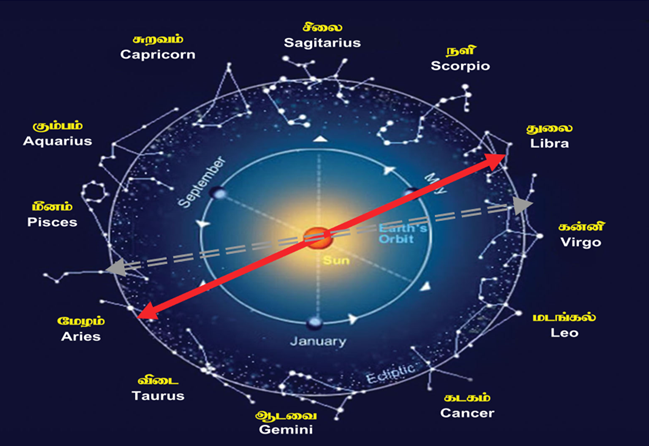 |
ஊழி - Oozhi -aeon origin point known as the Fiducial
Goat origin point. “The surgical or splitter path and the
balanced rod of Libra" (Silappathikaram Maduraikandam: 14/207). |
The Three-Dimensional Geometrical Coordinate System is
structured using three intersecting planes. The Fiducial or Anchor Stellar
Axis, which remains fixed and constant (aligned with the Chitra–Spica the
cutter or splitter star ), is aligned with the Meridian (longitude).
Together with the Sun’s Ecliptic Coordinate Axis and the Celestial
Coordinate Axis, these form the intersecting coordinate framework of the
Three-Dimensional Geometrical Coordinate System, defining the aeon origin
point. This intersecting coordinate framework represents the Tamilar
Astro-Time Mathematical Model. This serves as a remarkable method for
determining and monitoring the galactic expansion within the framework of the
12 zodiac constellations.

Tamil astronomical calendrical time-mathematical model:
Three-Dimensional Geometrical Coordinate System. An unchanging, fixed body (Pole
Star) serves as the Fiducial or Anchor Stellar Axis. Using the Meridian as a
reference, the Ecliptic Coordinate Axis and Celestial Coordinate Axis form an
intersecting framework—this represents an Aerospace 3-D model.
3. Vernal Equinox Alignment:
Falling during the vernal equinox (in the Northern Hemisphere), it
allows the measurement of equal day and night (12 hours each) and
ensures zero shadow at the Earth's equator. The Sun is directly
above the equator, with Earth's 23.5° axial tilt perpendicular to its
rays, causing the terminator line to pass through the poles, ensuring
equal sunlight worldwide. This equal day and night (12 hours each) leads to the Savamana year
prediction, which enables the calculation of the year matrix as 360 days (Thirumanthiram. 10.4.9.13) instead of 365 or 366 days for specific
calendrical calculations as stated by great saint Thirumular. This event marks the
six seasons—Spring, Summer, Monsoon, Autumn, Winter, and Prevenal—as stated in
both Tholkappiyam (Verses 952-957) and Pingalar Nigandu (Pingalam 212). Tholkappiyam
was the first Tamil literature to define six major seasons: Ilavenil (early
summer), Mudhuvenil (late summer), Kaar (monsoon), Kuthir (autumn), Munpani
(winter), and Pinpani (prevenal). It classifies time into Perumpozhudu
(major seasons), implicitly further divided into Mezhavizhu (vernal
equinox) and Thulaivizhu (autumnal equinox). Mezhavizhu
aligns with Ilavenil (early summer) in Chithirai (April-May), while Thulaivizhu
corresponds to Kuthir (autumn) in Aippasi (October-November), accurately
marking the six-month seasonal cycle.
4.
Lunar Eclipse Observation:
Capturing the Sun-Moon alignment at vertically zero and horizontally 180 degrees ensures the interception of
the Lunar and Solar systems. This enables precise measurement of
the Moon's nodes (Rahu இராகு/கருங்கோள்-Caput Draconis and Ketu கேது /செங்கோள் - Cauda Draconis). Therefore, in Tamil
Astronomical Pentadic Science, known as Ainthiram Panchangam, the Moon's nodes—
Rahu -Caput Draconis (ascending
node) and Ketu-Cauda Draconis
(descending node)—are crucial as shadow planets for measuring solar and lunar
eclipses.
5. Best Alignment (0°):
When the Sun, Moon and larger planets (Jupiter, Saturn) in the Lunar Solar
Steller system align at 0 degrees, it marks the Aeon of Best Alignment. This phenomenon
allows the unification of sidereal, solar, lunar, Jovian, and Saturnian year predictions, forming the basis
of the Tamil 60-year Cyclic Calendrical Prediction System (a form of the
Sexagesimal Base System).
6. North Pole Star Observation:
The Tamils meticulously observed the
North Star to track Earth’s axial tilt and precession. Cultural traditions,
such as observing the North Star during marriage ceremonies, reflected their
deep understanding of celestial mechanics.
"Like the steadfast Pole Star
(Vadameen – North Star), she remained devoted and steadfast in virtue." —
Kalithogai 221
Although Earth's axial tilt and
precession gradually shift over millennia, the North Star remains fixed for
extended periods, serving as a crucial reference point. The slow movement of
axial precession (precession of the equinoxes) causes the celestial pole to
trace a circular path, aligning with different stars over time. This cycle,
which passes through stars such as Polaris, Deneb, Vega, and Alpha Draconis,
completes a full 360-degree revolution approximately every 25,772 years
(~26,000 years).
Chithirai Tamil New Year: The Benchmark for Astronomical
Timekeeping
The
Chithirai Tamil New Year serves
as a fundamental reference point for
measuring time across multiple celestial cycles. It functions as the starting point for tracking the Savamana year, Jovian (Jupiter) year, Saturnian year, Lunar year,
Tropical solar year, Sidereal year, and most importantly,
determining the Oozhi (ஊழி) consecutive year—a
long-duration time measurement system developed by the Tamils.

The Tamils employed an advanced astronomical system to calibrate time intervals, using Chithirai New Year as a benchmark for planetary movements and a framework for their calendrical computations. This precision allowed them to monitor shifts in the Earth, Sun, Moon, planetary orbits, and stellar positions with remarkable accuracy.
Conclusion
The Chithirai Tamil New Year is not merely a cultural
celebration but a scientific marvel that reflects the Tamil mastery of astronomy. Through the Ainthiram Panchangam, Tamils developed
a time-measuring system that integrates solar, lunar, and stellar
calculations, demonstrating their profound understanding of the cosmos. This
ancient system, validated by modern astronomy, stands as a testament to
the scientific and cultural legacy of the Tamil
civilization. By celebrating the Chithirai Tamil New Year, we honour not only
our heritage but also the timeless wisdom of our ancestors.
************Thank you *******************
There are
countless ways one could be prevented from thinking. But the only way to
perceive the truth is to glide along with it, allowing it to blossom and reveal
itself.
‘உண்மையொடு ஊ ஊழியசே’ – சுமேரிய தமிழ் (கி.மு. 2094–2047) சூல்கியின் பாசுரம்
நம்முள் உண்மை ஊழ்ந்து (முதிர்ந்து) இசைய (அசைய), என்றுமே அதனோடு ஊர்ந்து செல்வோம்.
‘Uṇmaiyodu
ū ūliyasē (un-mey-da u-ul-li-a se)’ – Sumerian Tamil (B.C. 2094–2047), Sulgi's
Hymn B
"When the truth blossoms, harmonizes and resonates within our psyche, may
we continuously glide with it.
